
Table of Contents
If you have been diagnosed with degenerative disc disease, you are probably wondering what lies ahead. The condition typically progresses through several stages over many years, beginning with minor wear and tear in your twenties or thirties and potentially advancing to significant disc height loss and chronic pain by your fifties or sixties. The good news is that progression is not inevitable for everyone, and many people experience periods of stability or even improvement with proper management. Understanding how this condition evolves can help you take proactive steps to slow its advancement and maintain your quality of life.
Degenerative disc disease is something of a misnomer because it is not actually a disease but rather a natural aging process that affects the cushioning discs between your vertebrae. These discs act as shock absorbers for your spine, and as we age, they gradually lose water content, become less flexible, and may develop small tears. While some degree of disc degeneration is normal and happens to almost everyone, some people experience pain and other symptoms that significantly impact their daily activities.
Understanding Disc Degeneration
The progression of disc degeneration typically unfolds in three distinct stages.
In the early stage, usually occurring in your twenties through forties, the discs begin to lose water content and become slightly less springy. You might not notice any symptoms during this phase, or you may experience occasional back stiffness or mild discomfort after prolonged sitting or physical activity. The disc’s outer layer, called the annulus fibrosus, may develop tiny tears, though the disc largely maintains its shape and function.
During the intermediate stage, which often occurs in your forties through sixties, the discs continue to dry out and lose height. The space between vertebrae narrows, which can affect the alignment of your spine and put additional stress on the facet joints. You may notice more frequent episodes of back pain, stiffness that lasts longer, and reduced flexibility. Some people develop painful flare-ups that can last days or weeks before subsiding.
The advanced stage typically develops after age sixty, though timing varies considerably among individuals. By this point, significant disc height loss has occurred, and the disc may bulge or herniate. The narrowed disc space can lead to bone spurs as your body attempts to stabilize the affected area. Pain may become more persistent, and you might experience radiating discomfort into your arms or legs if nerves become compressed.
Risk Factors to Consider
Several factors influence how quickly degenerative disc disease progresses and how severely it affects you.
1. Genetics
Genetics plays a significant role. If your parents or siblings experienced significant disc problems, you may be more susceptible. Smoking accelerates disc degeneration by reducing blood flow to spinal tissues and impairing the disc’s ability to absorb nutrients and repair itself.
2. Obesity
Obesity places additional mechanical stress on your spinal discs, particularly in the lower back, accelerating wear and tear. Occupations or activities that involve repetitive heavy lifting, bending, or twisting put extra strain on your discs and may speed up degeneration. Conversely, a sedentary lifestyle weakens the muscles that support your spine, leaving discs vulnerable to injury.
3. Previous Spine Injuries
Previous spine injuries, even from years ago, can create weak points in discs that degenerate more rapidly than others. Autoimmune conditions and certain metabolic disorders can also affect disc health, though these connections are less direct than mechanical factors.
Diagnosing Degenerative Disc Disease
If you are experiencing persistent back pain, your doctor will begin with a thorough physical examination and medical history. They will ask about the location and nature of your pain, what makes it better or worse, and how it affects your daily activities. The physical exam typically includes assessments of your range of motion, reflexes, muscle strength, and tenderness in specific areas.
X-Rays
While a physical examination provides important clues, imaging studies are essential for confirming degenerative disc disease and determining its severity. X-rays can reveal disc space narrowing, bone spurs, and changes in spinal alignment, providing a basic picture of structural changes. However, X-rays cannot show the discs themselves or soft tissue damage.
MRI Scans
An MRI scan offers the most detailed view of your spinal discs and surrounding structures. This imaging technique can reveal the water content of your discs, detect tears in the disc’s outer layer, identify disc bulges or herniations, and show whether any nerves are being compressed. The MRI provides such detailed information that it has become the gold standard for diagnosing and monitoring degenerative disc disease.
Other Tests
In some cases, your doctor might order a CT scan, which provides excellent bone detail and can be useful if you cannot undergo an MRI. Occasionally, a discogram, a specialized test where dye is injected into the disc, may be performed if there is uncertainty about which disc is causing pain.
Complications: Spinal Stenosis
As degenerative disc disease progresses, it can lead to several complications that extend beyond simple disc problems. One of the most significant is spinal stenosis, a narrowing of the spaces within your spine that can put pressure on the nerves traveling through it. This occurs when disc height loss, bone spurs, and thickened ligaments collectively reduce the space available for your spinal cord and nerve roots.
Spinal stenosis typically develops gradually over many years. In the lower back, it can cause pain, numbness, or weakness in your legs, particularly when walking or standing for extended periods. In the neck, it may lead to similar symptoms in your arms or, in severe cases, problems with coordination and walking. While spinal stenosis is a serious complication, it does not develop in everyone with degenerative disc disease, and its progression can often be slowed with appropriate treatment.
Nonsurgical Treatments
The vast majority of people with degenerative disc disease find relief through conservative, nonsurgical approaches.
Chiropractic Care and Spinal Decompression
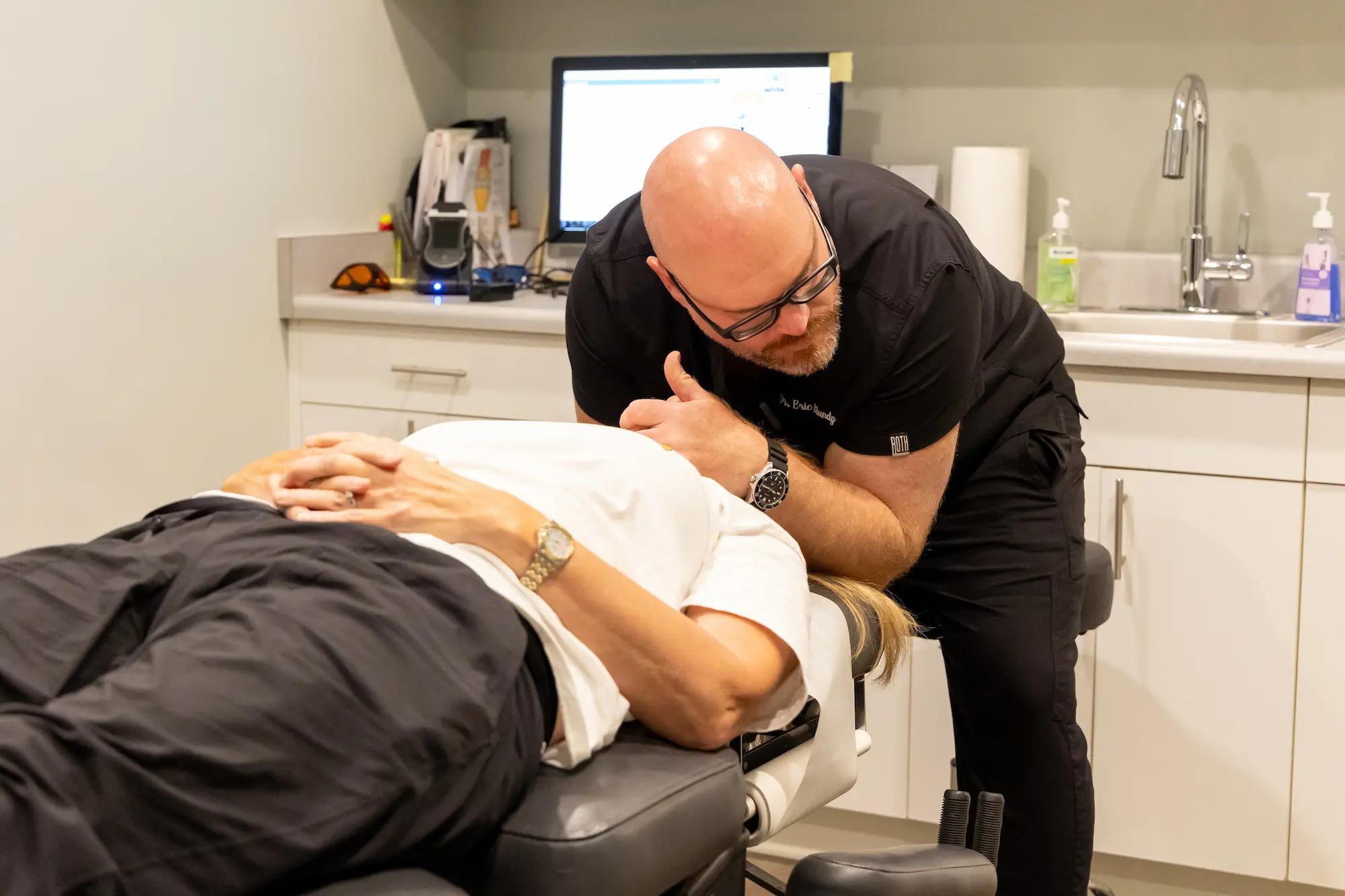
For patients with degenerative disc disease, chiropractic care combined with spinal decompression therapy addresses the mechanical source of disc pain directly. Decompression reduces intradiscal pressure, creates space for damaged discs to rehydrate, and takes load off compressed nerve roots, while chiropractic adjustments restore proper spinal mechanics and reduce stress on the affected levels.
Medications
Medications play an important supporting role. Over-the-counter pain relievers like acetaminophen or nonsteroidal anti-inflammatory drugs can manage mild to moderate pain. For more severe symptoms, your doctor might prescribe muscle relaxants or, during acute flare-ups, short courses of stronger pain medications. Some people benefit from injections of corticosteroids into the epidural space, which can reduce inflammation around affected nerves.
Regenerative Medicine
For patients where biological support for disc and joint tissue is part of the clinical picture, regenerative medicine offers therapies that work at the cellular level to reduce inflammation and support tissue repair. This can be a meaningful option for patients who want to address the underlying biology of disc degeneration rather than only managing symptoms.
Self-Care
Taking an active role in managing your condition can significantly influence its progression.
Regular low-impact exercise is perhaps the most important self-care measure you can take. Activities like swimming, walking, cycling, and yoga keep your spine flexible, strengthen supporting muscles, and promote the flow of nutrients to your discs without placing excessive stress on them.
Maintaining a healthy weight reduces mechanical stress on your spine, potentially slowing disc degeneration. Practicing good posture throughout the day, whether sitting, standing, or lying down, minimizes unnecessary strain on your discs. When lifting objects, use your legs rather than your back, and avoid twisting motions while holding weight.
Ergonomic adjustments to your workspace and sleeping environment can make a substantial difference. Ensure your chair provides adequate lumbar support, position your computer monitor at eye level, and choose a mattress that maintains your spine’s natural alignment. Quitting smoking delivers real benefits for your spinal health beyond general wellness improvements.
Final Thoughts on Degenerative Disc Disease Progression
While you cannot completely stop degenerative disc disease, understanding how it develops allows you to take meaningful action at every stage. Whether you are dealing with lumbar degenerative disc disease affecting your lower back or neck pain stemming from cervical disc problems, your spine is more resilient than most people realize. Intervention at any stage can improve outcomes, slow progression, and reduce the likelihood of reaching the point where surgery becomes the conversation.
For those experiencing significant pain from herniated discs or nerve compression within the spinal canal, working with specialists who understand both the neurological and structural dimensions of spinal conditions is critical. Whether you are managing early-stage changes or dealing with long-standing degeneration, the goal remains consistent: meaningful pain relief, preserved function, and the best possible quality of life through a care plan built around your specific situation. Contact the Spine Care team in Seneca to schedule your evaluation and find out what non-surgical options are available for your case.